Once African Americans were given the right to vote (1870), less than 5% of them actually exercised that right because southern states set up literacy tests that had to be passed in order to vote. For the white man, these tests were not a problem, but for a black man or woman these tests were a huge barrier. After years and years of slavery followed by years of inequity in education and schooling, many blacks did not know how to read or write. This helped the white man ensure that although the black man had the right to vote, he would never be able to act on it..... Because of these situations throughout the south, many Civil Rights' activists were determined to make a change. They set up voting clinics throughout the south where they worked with African Americans, helping them to pass the literacy tests and become officially registered to vote. Their efforts were met with violent repression from state and local lawmen, White Citizens' Council, and Ku Klux Klan resulting in beatings, hundreds of arrests and the murder of several voting activists as seen in this clip from the film "Mississippi Burning".
After watching this clip, discuss in your groups how it is possible to have laws on paper that are not enforced in practice. What examples of hypocrisy do we see in government and policy in the 1960s and still today? How can this double standard be stopped? Or can it be? Now imagine Raisin in the Sun's "Walter".... Think about the frustrations he feels. Does understanding the environment help you to understand him a bit more? How does a generation of people move beyond these kinds of things that were done TO them, AROUND them, and BECAUSE of their skin color? Or do they?
01 April 2011

30 March 2011
Louis Armstrong & the Harlem Renaissance
 Your group's task is to analyze a
 Collection of five songs by Louis Armstrong. Before you began your analysis, you need a bit
of background information about Mr. Armstrong.
Louis Armstrong was born in 1901 in New Orleans, Louisiana and died at the age of 69 in New York. He came to prominence in the 1920s as an "inventive" cornet and trumpet player and was a foundational influence in jazz.
Armstrong had what many, today, would refer to as a traumatic or dysfunctional childhood. Out of this environment was born a desire to succeed, be admired, and make people happy. Louis learned at an early age that music could lead to fame and money. He and his friends would sing for nickels and pennies on the streets of his native New Orleans and he saw how popular the musicians who played the funeral and celebratory parades were with the public. On New Year’s Eve in 1913, when he was only 12 years old, Armstrong was caught firing a gun into the air and sentenced to a boys home for orphans. It was here under the guidance of Peter Davis, who ran the home, that Armstrong learned how to play the cornet and he was soon playing picnics and parades. Later in life Louis returned year after year to the same orphanage to spread his joy to whoever was staying there at that time. He never forgot Peter Davis.
With his instantly recognizable deep and distinctive gravelly voice, Armstrong was also an influential singer, demonstrating great dexterity as an improviser, bending the lyrics and melody of a song for expressive purposes. Renowned for his charismatic stage presence and voice almost as much as for his trumpet-playing, Armstrong's influence extends well beyond jazz music, and by the end of his career in the 1960s, he was widely regarded as a profound influence on popular music in general.
Armstrong was one of the first truly popular African-American entertainers to "cross over," whose skin color was secondary to his amazing talent in an America that was severely racially divided. It allowed him socially acceptable access to the upper echelons of American society that were highly restricted for a person of color. While he rarely publicly politicized his race, often to the dismay of fellow African-Americans, he was privately a huge supporter of the Civil Rights Movement in the 1960s.
__________________________Your Group's Task: Step 1-Listen to each song, while at the same time reading the lyrics. Step 2- Come to a consensus as a group about what each song means (according to the lyrics, the tone, the rhythm, etc). Step 3-Discuss the 5 songs as a "collection" from the era of the Harlem Renaissance. Knowing what you know about the Harlem Renaissance, do you feel that this collection reflects the era of the H.R. or is it something different? Step 4- Compare this collection from Louis Armstrong to the collection of poems from Langston Hughes. What similarities can you find? What differences? _____________________________________________________
1. Mack the Knife
Oh, the shark, has, pretty teeth, dear....and he shows them, pearly white Just a jackknife, has macheath, yeah.....and he keeps it, out of sight When the shark bites, with his teeth, dear....scarlet billows start to spread Fancy gloves, though, wears macheath, yeah..so there’s not a trace, hmmmm of red On the sidewalk...sunday morning, ...lies a body oozin’ life Someone’s sneakin’ ’round the corner...is the someone, mack the knife? From a tugboat.... by the river..... a cement bag’s, droopin’ down Yeah, the cement’s just for the weight, dear...bet you mack, he’s back in town Looky here louie miller, disappeared dear...after drawing, out his cash And macheath spends, like a sailor...did our boy do, somethin’ rash? Sukey tawdry, jenny diver..lotte lenya, sweet lucy brown Oh, the line forms on the right, dears.....now that macky’s back in town
________________________________________________
2. When the Saints Go Marching In
We are traveling in the footsteps Of those who’ve gone before But we’ll all be reunited (but if we stand reunited) On a new and sunlit shore (then a new world is in store) Oh when the saints go marching in When the saints go marching in Oh lord I want to be in that number When the saints go marching in And when the sun refuse (begins) to shine And when the sun refuse (begins) to shine Oh lord I want to be in that number When the saints go marching in When the moon turns red with blood When the moon turns red with blood Oh lord I want to be in that number When the saints go marching in On that hallelujah day On that hallelujah day Oh lord I want to be in that number When the saints go marching in Oh when the trumpet sounds the call Oh when the trumpet sounds the call Oh lord I want to be in that number When the saints go marching in Some say this world of trouble Is the only one we need But I’m waiting for that morning When the new world is revealed When the revelation (revolution) comes When the revelation (revolution) comes Oh lord I want to be in that number When the saints go marching in When the rich go out and work When the rich go out and work Oh lord I want to be in that number When the saints go marching in When the air is pure and clean When the air is pure and clean Oh lord I want to be in that number When the saints go marching in When we all have food to eat When we all have food to eat Oh lord I want to be in that number When the saints go marching in When our leaders learn to cry When our leaders learn to cry Oh lord I want to be in that number When the saints go marching in
________________________________________________
3. Nobody Knows
Nobody knows the trouble I've seen Nobody knows but Jesus Nobody knows the trouble I've seen Glory, Hallelujah Sometimes I'm up, sometimes I'm down, ohh, yes Lord Sometimes I'm almost To the ground, oh yes, Lord Nobody knows the trouble I've seen Nobody knows but Jesus Anybody knows the trouble I've seen Glory, Hallelujah If you got there before I do, oh yes Lord Tell all my friends, I'm Coming too, oh yes Lord Nobody knows the trouble I've seen Nobody knows but Jesus Nobody knows the trouble I've seen Glory, Hallelujah Although you see me Goin' on so, oh yes I have my trials, here below Ohh yes, Lord Oh, nobody knows the trouble I've seen Nobody knows but Jesus Nobody knows the trouble I've seen Glory, Hallelujah Ohh, glory, Hallelujah
________________________________________________
4. When You're Smiling
When you're smilin'....keep on smilin' The whole world smiles with you And when you're laughin'....keep on laughin' The sun comes shinin' through But when you're cryin'.... you bring on the rain So stop your frownin'....be happy again Cause when you're smilin'....keep on smilin' The whole world smiles with you (instrumental break) Oh when you're smilin'....keep on smilin' The whole world smiles with you Ah when you're laughin'....keep on laughin' The sun comes shinin' through Now when you're cryin'.... you bring on the rain So stop that sighin'....be happy again Cause when you're smilin'....just keep on smilin' And the whole world gonna smile with The great big world will smile with The whole wide world will smile with you
________________________________________________
5. What a Wonderful World
I see trees of green, red roses too I see them bloom for me and you And I think to myself what a wonderful world. I see skies of blue and clouds of white The bright blessed day, the dark sacred night And I think to myself what a wonderful world. The colors of the rainbow so pretty in the sky Are also on the faces of people going by I see friends shaking hands saying how do you do They're really saying I love you. I hear babies cry, I watch them grow They'll learn much more than I'll never know And I think to myself what a wonderful world Yes I think to myself what a wonderful world.
25 March 2011
Raisin in the Sun & the "Jim Crow" South
It is important to understand what was happening in the US at the time that A Raisin in the Sun is set and the place to start the understanding is by finding out... WHO WAS JIM CROW?
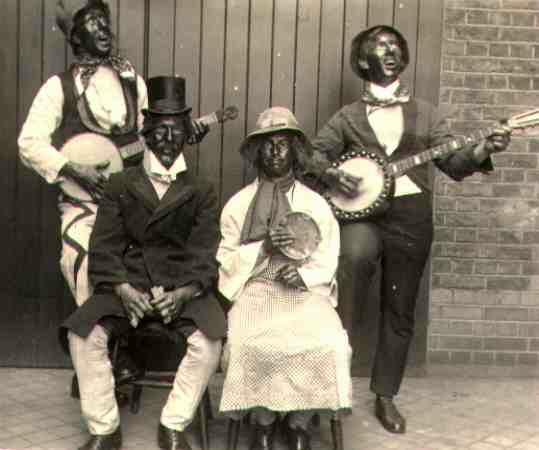
Describe this picture of "Jim Crow" and discuss in your group how you feel when you look at it. Are the feelings positive, negative, happy, entertaining, degrading, or something else? Why?
Describe this picture of "Jim Crow" and discuss in your group how you feel when you look at it. Are the feelings positive, negative, happy, entertaining, degrading, or something else? Why?
If you were to learn that this image represents a white man dressed up with black paint on his face, meant to mimic the black man, does that change your thoughts about the image at all?
A little background information:
The minstrel show was an American entertainment consisting of comic skits, variety acts, dancing, and music, performed by white people in blackface. Minstrel shows lampooned black people in mostly disparaging ways: as ignorant, lazy, buffoonish, superstitious, and musical. The minstrel show began with brief burlesques and comic acts in the early 1830s and emerged as a full-fledged form in the next decade.
Watch 2 examples of an old Minstrel skit.
As you watch it, think about the following items:
1. Is this type of entertainment appropriate or not?
2. What is the message behind this type of entertainment?
3. Should it have been allowed?
4. What was its purpose?
5. How did it make you feel as you watched it?
6. And finally..... would you have felt differently if you were an African American watching this?
Now look at the following images associated with "Minstrel entertainment".
Are these images examples of FREEDOM OF SPEECH or are they examples of BIGOTRY?
How far does FREE SPEECH "cover" you?




Or are there consequences of our exercising our Freedom of Speech? What are the consequences of things like the MINSTREL SHOWS and these ads?
Should there be a "limit" to our freedom of speech?
A Raisin in the Sun
The Civil War in the Unite d States was fought from 1861-1865.
In 1863 President Abraham Lincoln signed the

Sure....they could move NORTH because things must be better there, right?!
d States was fought from 1861-1865.In 1863 President Abraham Lincoln signed the
which formally abolished slavery in the United States and declared all men free when it said:
"That on the 1st day of January, A.D. 1863, all persons held as slaves within any State or designated part of a State the people whereof shall then be in rebellion against the United States shall be then, thenceforward, and forever free...."
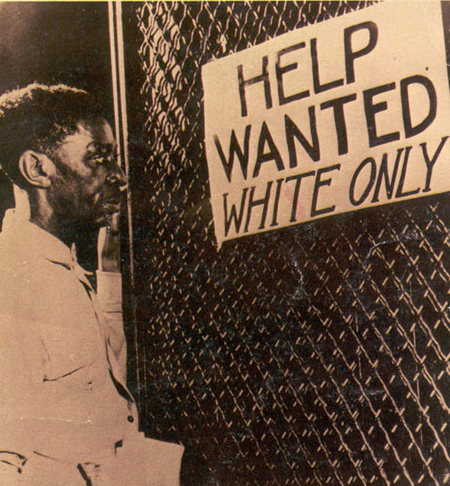
So how is it possible that ONE HUNDRED YEARS LATER, the Jim Crow Laws could still be in effect?
Your group's task:
Look at each of the following pictures which are examples of Jim Crow Laws throughout the southern United States in the 20th century.
How do they make you feel?
What do they make you want to do/say when you see them?




What about statements such as these about Jim Crow Laws:
1. One rationale for the systematic exclusion of Black Americans from southern public society was that it was for their own protection.....
2. Allowing Blacks in White schools would mean constantly subjecting them to adverse feelings and opinions which would not be fair for them to experience....
How do these make you feel when you hear them? What could members of society do to actually change these opinions, these laws, and these ways of thinking?!!? Could they do anything?
Sure....they could move NORTH because things must be better there, right?!
13 December 2010
The Role of Media in our Lives
How much influence does the media have on our lives?

Do we, as the human race, have the power to block out what they are telling us and make our own decisions and choices?

Who is ultimately responsible for what the media "feeds" us?
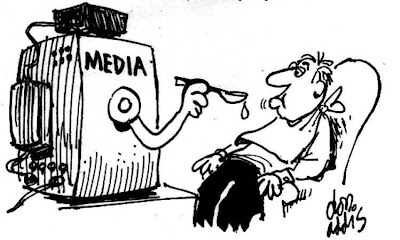
Think about "messages" that the media has given you in the past about a story or a situation or a group of people. Have any of these messages ever angered you?
How far does a journalist go to "get a story"; or how far SHOULD he go to get a story?
And now the 6 million dollar questions:
SHOULD THE MEDIA EVER BE CENSORED?
What about this example of a regular radio broadcast in Rwanda prior to the genocide of 1994:
"You have to kill the Tutsis; they're cockroaches.
All those who are listening, rise so we can fight for our Rwanda. Fight with the weapons you have at your disposal: those who have arrows, use arrows. Those who have spears, use spears. We must all fight.
We must all fight the Tutsis. We must finish them, exterminate them, sweep them from the whole country. There must be no refuge for them.
They must be exterminated. There is no other way."
Here is an example of the media attempting to SWAY its audience:
Here is an example... MOSQUE AT GROUND ZERO
How do we BLOCK it out and make our own decisions?

Do we, as the human race, have the power to block out what they are telling us and make our own decisions and choices?

Who is ultimately responsible for what the media "feeds" us?

Think about "messages" that the media has given you in the past about a story or a situation or a group of people. Have any of these messages ever angered you?
How far does a journalist go to "get a story"; or how far SHOULD he go to get a story?
And now the 6 million dollar questions:
SHOULD THE MEDIA EVER BE CENSORED?
What about this example of a regular radio broadcast in Rwanda prior to the genocide of 1994:
"You have to kill the Tutsis; they're cockroaches.
All those who are listening, rise so we can fight for our Rwanda. Fight with the weapons you have at your disposal: those who have arrows, use arrows. Those who have spears, use spears. We must all fight.
We must all fight the Tutsis. We must finish them, exterminate them, sweep them from the whole country. There must be no refuge for them.
They must be exterminated. There is no other way."
Here is an example of the media attempting to SWAY its audience:
Here is an example... MOSQUE AT GROUND ZERO
How do we BLOCK it out and make our own decisions?
10 December 2010
Part 2- In Class Writing

Part 2 (Chapters 4-6)
Describe Loung's behavior in these chapters. Is her behavior that of a "typical spoiled five year old"?
The Power of Words
As you consider Maya Angelou's poem "The Calling of Names", think about this incident that happened on April 4, 2007.
Meet Don Imus, radio talk show host:

Meet the Rutgers University Lady's Basketball Team:

During a discussion about the NCAA Women's Basketball Championship, Imus characterized the Rutgers University women's basketball team players as "rough girls" commenting on their tattoos.
His executive producer Bernard McGuirk responded by referring to them as "hardcore hos". The discussion continued with Imus describing the girls as "nappy-headed hos" and McGuirk remarking that the two teams looked like the "jigaboos versus the wannabes" mentioned in Spike Lee's film, School Daze; apparently referring to the two teams' differing appearances.
IMUS: That's some rough girls from Rutgers. Man, they got tattoos and—
McGUIRK: Some hard-core hos.
IMUS: That's some nappy-headed hos. I'm gonna tell you that now, man, that's some—whew. And the girls from Tennessee, they all look cute, you know, so, like—kinda like—I don't know.
McGUIRK: A Spike Lee thing.
IMUS: Yeah.
McGUIRK: The Jigaboos vs. the Wannabes—that movie that he had.
After some outrage from the initial repeated reports, Imus dismissed the incident as "some idiot comment meant to be amusing".
Imus immediately issued a statement of apology:
I want to take a moment to apologize for an insensitive and ill-conceived remark we made the other morning regarding the Rutgers women's basketball team, which lost to Tennessee in the NCAA championship game on Tuesday. It was completely inappropriate and we can understand why people were offended. Our characterization was thoughtless and stupid, and we are sorry.
Imus said, "Our agenda is to be funny and sometimes we go too far. And this time we went way too far. Here's what I've learned: that you can't make fun of everybody, because some people don't deserve it."
Should Imus have been fired?
Is there ever an "appropriate" time for name-calling?
What effect can name-calling have on society?
Here is what poet Maya Angelou had to say on the subject; as you listen think about the words of her poem "The Calling of Names" that we have analyzed earlier today:
http://www.youtube.com/watch?v=0n9Pq1LNLwM
Meet Don Imus, radio talk show host:

Meet the Rutgers University Lady's Basketball Team:

During a discussion about the NCAA Women's Basketball Championship, Imus characterized the Rutgers University women's basketball team players as "rough girls" commenting on their tattoos.
His executive producer Bernard McGuirk responded by referring to them as "hardcore hos". The discussion continued with Imus describing the girls as "nappy-headed hos" and McGuirk remarking that the two teams looked like the "jigaboos versus the wannabes" mentioned in Spike Lee's film, School Daze; apparently referring to the two teams' differing appearances.
IMUS: That's some rough girls from Rutgers. Man, they got tattoos and—
McGUIRK: Some hard-core hos.
IMUS: That's some nappy-headed hos. I'm gonna tell you that now, man, that's some—whew. And the girls from Tennessee, they all look cute, you know, so, like—kinda like—I don't know.
McGUIRK: A Spike Lee thing.
IMUS: Yeah.
McGUIRK: The Jigaboos vs. the Wannabes—that movie that he had.
After some outrage from the initial repeated reports, Imus dismissed the incident as "some idiot comment meant to be amusing".
Imus immediately issued a statement of apology:
I want to take a moment to apologize for an insensitive and ill-conceived remark we made the other morning regarding the Rutgers women's basketball team, which lost to Tennessee in the NCAA championship game on Tuesday. It was completely inappropriate and we can understand why people were offended. Our characterization was thoughtless and stupid, and we are sorry.
Imus said, "Our agenda is to be funny and sometimes we go too far. And this time we went way too far. Here's what I've learned: that you can't make fun of everybody, because some people don't deserve it."
Should Imus have been fired?
Is there ever an "appropriate" time for name-calling?
What effect can name-calling have on society?
Here is what poet Maya Angelou had to say on the subject; as you listen think about the words of her poem "The Calling of Names" that we have analyzed earlier today:
http://www.youtube.com/watch?v=0n9Pq1LNLwM
02 December 2010
What were The Killing Fields?
This film was released in 1984 and follows the story of an American journalist, Sydney Schanberg and Dith Pran, his Cambodian interpreter and fellow journalist. They have been working in the Cambodia, reporting the events of the civil war that was going on in the early 1970s. However, in 1975 everything changed.
On April 17, 1975, Cambodia's capital city, Phnom Penh, fell under the control of the Khmer Rouge, the communist guerilla group led by Pol Pot. They forced all city residents into the countryside and to labor camps. During the three years, eight months, and 20 days of Pol Pot’s rule, Cambodia faced its darkest days, an estimated 2 million Cambodians or 30% of the country’s population died by starvation, torture or execution. Almost every Cambodian family lost at least one relative during this gruesome holocaust.
________________________________________
Pol Pot's Year O
Pol Pot declared 'Year Zero' when Khmer Rouge captured Phnom Penh on April 17, 1975. He immediately directed a ruthless program to "purify" Cambodian society of capitalism, Western culture, religion and all foreign influences. He wanted to create Cambodia into an isolated and totally self-sufficient state. Anyone who opposed was killed. Foreigners were expelled, embassies closed, and the currency abolished. Markets, schools, newspapers, religious practices and private property were forbidden. The police, public servants, military officers, teachers, ethnic Vietnamese, Christian clergy, Muslim leaders, members of the Cham Muslim minority, members of the middle-class and the educated were identified and executed.
The country's entire population was forced to relocate to the agricultural labor camps, the so-called "killing fields". Inmates lived in primitive conditions. Families were separated. Former city residents were subjected to unending political indoctrination and brainwashing. Children were encouraged to spy on adults, including their parents.
An estimated 1.5 - 3 million worked or starved to death, died of disease or exposure, or were executed for committing crimes. These crimes which were punishable by death included: not working hard enough, complaining about living conditions, collecting or stealing food for personal consumption, wearing jewelry, engaging in sexual relations, grieving over the loss of relatives or friends and expressing religious sentiments

________________________________________
"We will be the first nation to create a completely Communist country without wasting our time on the intermediate steps." -Khmer Rouge Minister of Defense, Son Sen
"To spare you is no profit, to destroy you is no loss." -Khmer Rouge slogan
________________________________________
It is at this point we find Sydney Schanberg and Dith Pran. Sydney has been sent back to the United States, but his Cambodia colleague is forced to stay and sent to a work camp in the Killing Fields. Sydney is struggling to understand just who is responsible for these atrocities while his friend is struggling to stay alive.
________________________________________
An Introduction to "First They Killed my Father"
Watch the following photo story and answer these questions: What do you see? What do you know? What do you feel? What do you wonder?
The Cambodian Killing Fields lasted 3 years and 8 months and 20 days. But what were they? Who were the victims? And who were the guilty parties that caused them? All of these questions, as well as many others, will be answered as we follow the journey of Loung Ung in
The Cambodian Killing Fields lasted 3 years and 8 months and 20 days. But what were they? Who were the victims? And who were the guilty parties that caused them? All of these questions, as well as many others, will be answered as we follow the journey of Loung Ung in
21 September 2010
The Trial of George
Culminating Writing Assignment- a Persuasive Paper Of Mice and Men
Now that you have completed the novella, you should have a clear understanding about the events leading up to the death of Lennie. If Lennie had gone to trial for what he did, perhaps he would have been found innocent, on the grounds of a lack of mental competence Do you believe that George made the right decision? Was this a mercy killing? Was George justified? Or is George a murderer?
In this writing assignment we are putting George on trial for murdering Lennie. You are to take the position of either the prosecuting attorney or the attorney for George´s defense. This writing assignment represents your “closing arguments” to the jury as this is the time when a lawyer gives a final summary of his case and has his best efforts at persuading the jury to his side. Watch this example of an attorney's closing arguments to give you some ideas of how to convince the jury that YOUR side represents the truth.....
Your first step is to decide what side you will represent. Next begin to construct your case based on the description of persuasive writing below.
Persuasive writing, also known as the argument essay, utilizes logic and reason to show that one idea is more legitimate than another idea. It attempts to persuade a reader to adopt a certain point of view or to take a particular action. The argument must always use sound reasoning and solid evidence by stating facts, giving logical reasons, using examples, and quoting experts (as appropriate).
Note: Make sure that you cite all references, experts, or facts that you include.
Your essay should be be NO LESS than 2 pages and NO MORE than 3.
Your introductory paragraph will present your side and your concluding paragraph will make one final statement that really solidifies your case. The body paragraph(s) will be where you present the persuasive arguments and evidence that support your stance.
Mercy Killing or Murder?
Chapter 5-6 Of Mice and Men
Was the death of Lennie a mercy killing or cold-blooded murder? Why?
What kind of man is George? Did your opinion of him change when you read Chapter 6?
A tragic hero is the main character in a tragedy. The modern use of the term usually involves the notion that such a hero make an error in his actions that leads to his downfall.
Some common traits which are characteristic of a tragic protagonist:
Was the death of Lennie a mercy killing or cold-blooded murder? Why?
What kind of man is George? Did your opinion of him change when you read Chapter 6?
A tragic hero is the main character in a tragedy. The modern use of the term usually involves the notion that such a hero make an error in his actions that leads to his downfall.
Some common traits which are characteristic of a tragic protagonist:
- The flaw is most frequently Hubris.
- The hero discovers that he is a result of his own actions, not by things happening to him.
- The hero sees and understands his doom, and that his fate was revealed by his own actions.
- The hero learns something from his/her mistake.
- The hero is faced with a serious decision.
- The suffering of the hero is meaningful because although the suffering is a result of the hero's own volition, it is not wholly deserved and may be cruelly disproportionate.
Is George an example of THE TRAGIC HERO? If so, what is his TRAGIC FLAW?
17 September 2010


Want Ads for Lonely People
One of the sub-themes in Steinbeck's Of Mice and Men is LONELINESS.
Think about the following characters: GEORGE, CROOKS, CURLEY, and CURLEY'S WIFE.
What makes them lonely? What do they want out of life that they do not currently have?
Is each person's "loneliness" the same? Or is it different from person to person?
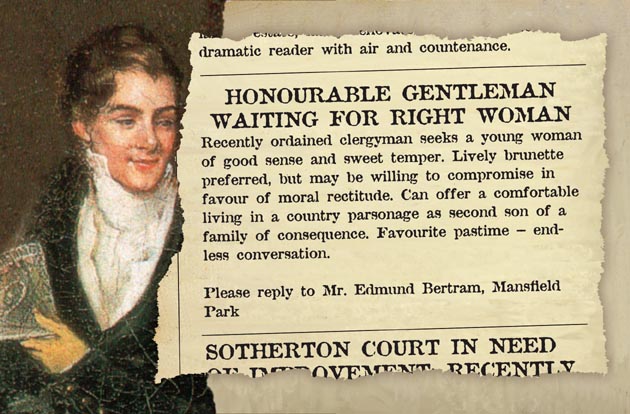
The following are examples of Personal Ads, both written by someone looking for something in his/life, something to replace his/her loneliness.

 '
'
Your group's task is to write a Personal Ad for each of the following characters from OMAM.
GEORGE, CROOKS, CURLEY, CURLEY'S WIFE
Your ad must reflect your group's understanding of each character and what makes him/her lonely as well as what kinds of things you think this person is looking for to replace the loneliness in his/her life.
Think about the following characters: GEORGE, CROOKS, CURLEY, and CURLEY'S WIFE.
What makes them lonely? What do they want out of life that they do not currently have?
Is each person's "loneliness" the same? Or is it different from person to person?
The following are examples of Personal Ads, both written by someone looking for something in his/life, something to replace his/her loneliness.
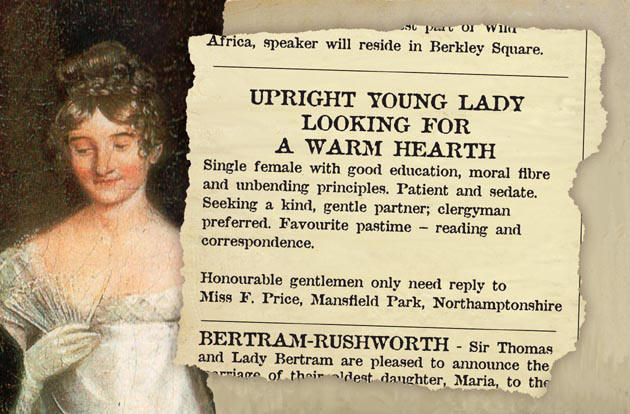 '
'Your group's task is to write a Personal Ad for each of the following characters from OMAM.
GEORGE, CROOKS, CURLEY, CURLEY'S WIFE
Your ad must reflect your group's understanding of each character and what makes him/her lonely as well as what kinds of things you think this person is looking for to replace the loneliness in his/her life.
16 September 2010
Conflict in OMAM
Conflict is all around us.... we see it every day in a variety of forms.
There are TWO different types of conflict-
INTERNAL & EXTERNAL.
INTERNAL CONFLICT is a battle that MAN has with HIMSELF.
EXTERNAL CONFLICT can occur in 3 different ways:
MAN against MAN
MAN against SOCIETY
MAN against NATURE

Your group's task:
Create a chart listing the 4 types of conflict and find examples in OMAM Chapters 1 through 4 of the various types.
There are TWO different types of conflict-
INTERNAL & EXTERNAL.
INTERNAL CONFLICT is a battle that MAN has with HIMSELF.
EXTERNAL CONFLICT can occur in 3 different ways:
MAN against MAN
MAN against SOCIETY
MAN against NATURE

Your group's task:
Create a chart listing the 4 types of conflict and find examples in OMAM Chapters 1 through 4 of the various types.
American Dream for all?? Even Crooks?
Think about all we have learned about Crooks, the "stable buck", in OMAM. Now think about what you know about "the American Dream". Is it truly for everyone? Or is there a separation between who can and who cannot achieve the American Dream?
10 September 2010
IRONY OMAM
Irony is defined as a difference or contrast between appearance and reality - that is a discrepancy between what appears to be true and what really is true. After reading Chapters 1-3, what irony can you find in Of Mice and Men?
3 Types of Irony-
1. Verbal irony occurs when people say the opposite of what they mean (and in its most bitter form becomes sarcasm.)
2. Situational irony is when the situation is different from what common sense indicates it is, will be, or ought to be.
3. Dramatic irony occurs when a character states something that they believe to be true but that the reader knows is not true.
3 Types of Irony-
1. Verbal irony occurs when people say the opposite of what they mean (and in its most bitter form becomes sarcasm.)
2. Situational irony is when the situation is different from what common sense indicates it is, will be, or ought to be.
3. Dramatic irony occurs when a character states something that they believe to be true but that the reader knows is not true.
07 September 2010
OMAM Chapter 2
The Picture of Friendship
Using the picture of friendship that you brought to class today,DESCRIBE what friendship LOOKS LIKE. What are its "physical" traits? How do you know if a relationship is a FRIENDSHIP? What separates it from other relationships?
Using the picture of friendship that you brought to class today,DESCRIBE what friendship LOOKS LIKE. What are its "physical" traits? How do you know if a relationship is a FRIENDSHIP? What separates it from other relationships?
30 August 2010
OMAM Chapter 1-You've Got a Friend
Chapter 1 gives us a first glance into the friendship of Lennie and George. Describe that relationship and talk about if you could see yourself in the role of George? Could you befriend a person like Lennie? Truly befriend.....?
11 August 2010
Defining the American Dream
The term "American Dream" was first used by James Truslow Adams in his book The Epic of America which was written in 1931. He states: "The American Dream is 'that dream of a land in which life should be better and richer and fuller for everyone, with opportunity for each according to ability or achievement. It is a difficult dream for the European upper classes to interpret adequately, and too many of us ourselves have grown weary and mistrustful of it. It is not a dream of motor cars and high wages merely, but a dream of social order in which each man and each woman shall be able to attain to the fullest stature of which they are innately capable, and be recognized by others for what they are, regardless of the fortuitous circumstances of birth or position.'"
In the United States’ Declaration of Independence, the founding fathers: "…held certain truths to be self-evident, that all Men are created equal, that they are endowed by their Creator with certain unalienable Rights, that among these are life, Liberty and the Pursuit of Happiness." Might this sentiment be considered the foundation of the American Dream?
So FOR WHOM is the American Dream? What do you "look like" when you have achieved it?
Was this 1950s television show close to the mark? Is this how you see the American family living the American dream?
Or could it look something like this family?

In the United States’ Declaration of Independence, the founding fathers: "…held certain truths to be self-evident, that all Men are created equal, that they are endowed by their Creator with certain unalienable Rights, that among these are life, Liberty and the Pursuit of Happiness." Might this sentiment be considered the foundation of the American Dream?
So FOR WHOM is the American Dream? What do you "look like" when you have achieved it?
Was this 1950s television show close to the mark? Is this how you see the American family living the American dream?
Or could it look something like this family?

10 August 2010
What is the American Dream?
Journal-
Respond to this quote by comedian, George Carlin.
What IS the American Dream???And is it just a dream??
Respond to this quote by comedian, George Carlin.
"They call it the American Dream
because you have to be asleep to believe it."
because you have to be asleep to believe it."
What IS the American Dream???
Subscribe to:
Posts (Atom)


